Belvoir House
Hugh Hamilton
I have known the Belvoir area of Belfast for many years and was always aware of the “Big House,” known as Belvoir House or Belvoir Park. I assumed that the name came from French, relating to the view. It seems natural to think that this view was to the west, across the River Lagan towards Malone House and Barnett Demesne. Something which puzzled me was why Belvoir was always pronounced “beaver”.
Belvoir House was probably the largest and grandest private dwelling in Belfast. Built in the mid-18th century, it stood within a demesne of over 6,000 acres. When a mansion of this scale was planned, great care would have been taken in choosing its exact position, and the views from the house would surely have been central to that decision.
The estate had once been the home of the Hill family. Michael Hill’s wife, Anne Trevor, who later married Viscount Midleton, is said to have given the place its name, in memory of Belvoir Castle, the Duke of Rutland’s ancestral home in Leicestershire, where she had spent much of her childhood.
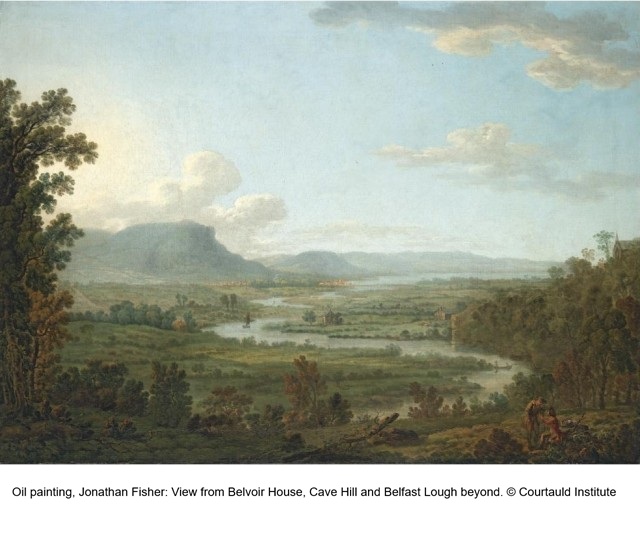
Image from Belvoir Park « The Irish Aesthete
Belvoir Castle was built on the top of a high hill. From its vantage point you can see landscapes from the surrounding counties of Nottinghamshire, Lincolnshire and Leicestershire. The name Belvoir was brought over by the French-speaking Normans in the 11th century. The name, which is Norman French for ‘beautiful view’, was well-given. As the Middle English–speaking Anglo-Saxons were unable to pronounce the name, they called it "Beaver Castle" – a usage which persists today and is also used for the Belvoir area of Belfast.
I remember, sometime around 2013, visiting the Ulster Museum and coming across a painting that stopped me in my tracks. It showed the view looking north from Belvoir House towards Belfast. The house stood high above the River Lagan, positioned so that the river could be seen winding its way towards Belfast Lough. In the distance were sailing ships on the lough and the hills beyond the city could be seen. The painting dated from when the house was newly completed and captured a landscape largely untouched by the urban expansion of Belfast. It offered a glimpse of Belfast before the Industrial Revolution, revealing just how beautiful the surrounding countryside once was. Just as Belvoir Castle was named for its beautiful view, looking at the painting, it is hard to imagine a more fitting name for Belvoir House.
One imagines that Anne Trevor felt the views from her Belfast home fully justified borrowing the name of her childhood residence.
The main elevation of Belvoir House faced north, with the principal rooms arranged to take full advantage of that view. Below on the north side of the house lay formal gardens, and nearby stood something far older - the Norman motte.
The motte was a defensive earthwork dating from around 1177, when the Norman invader John de Courcy established control over Ulster and built a network of fortifications to secure his position. The earthwork would originally have supported a timber palisade and tower, forming a small but effective stronghold. Its location was no accident. Medieval commanders would have chosen it carefully, both for early warning of approaching forces and for the defensive strength it offered. From the tower on this raised position there would have been clear views along the Lagan valley and across the surrounding approaches.
 It is striking to think that the builders of Belvoir House chose a site beside one selected for very similar reasons more than 500 years earlier.
Hugh Hamilton is a graduate of Queen’s University and has lived in Belfast since 1980. His main areas of research are family and local history.