Talk by Nigel Henderson: Belfast Street Names - Admirals, Generals and Battles
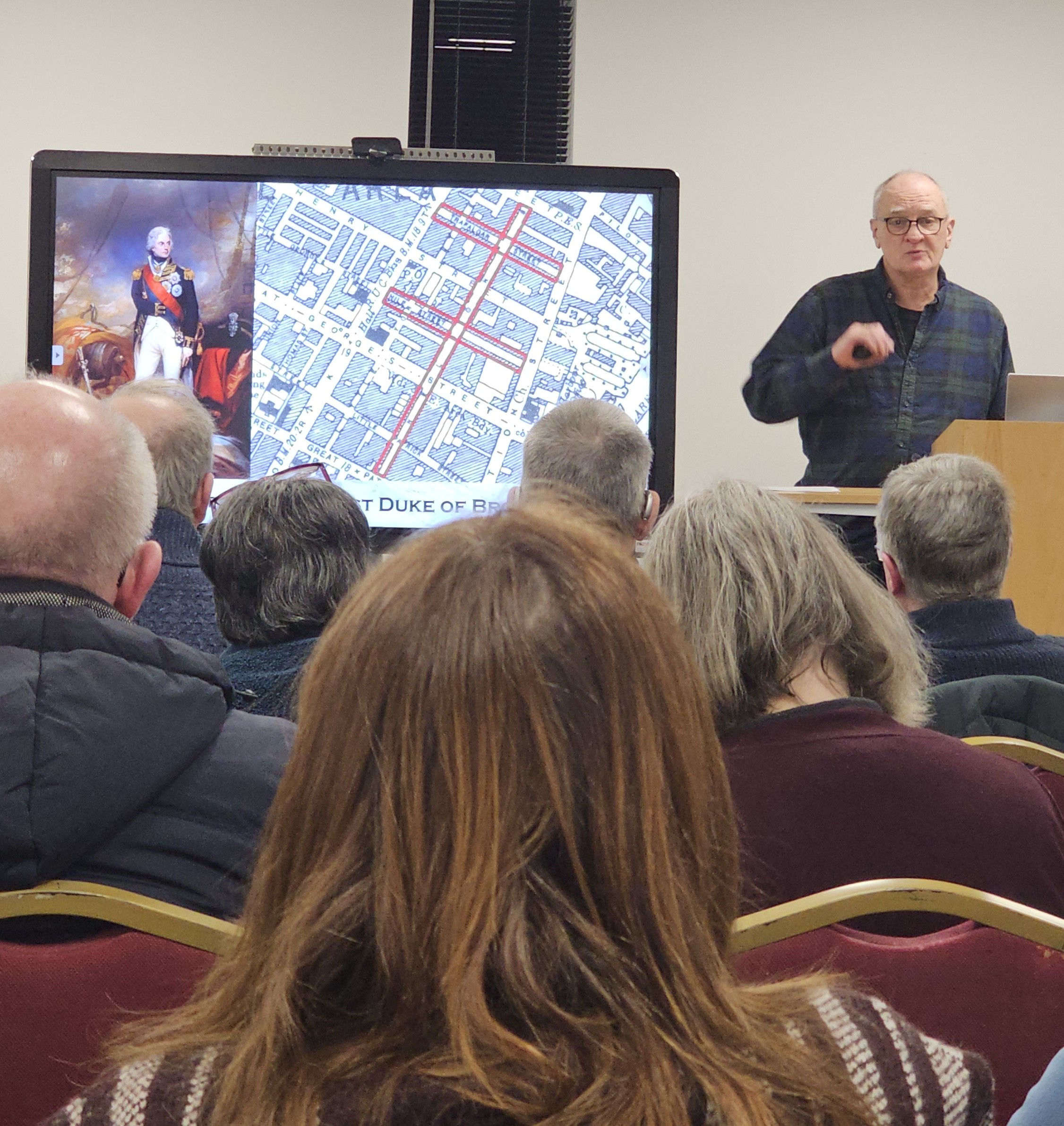
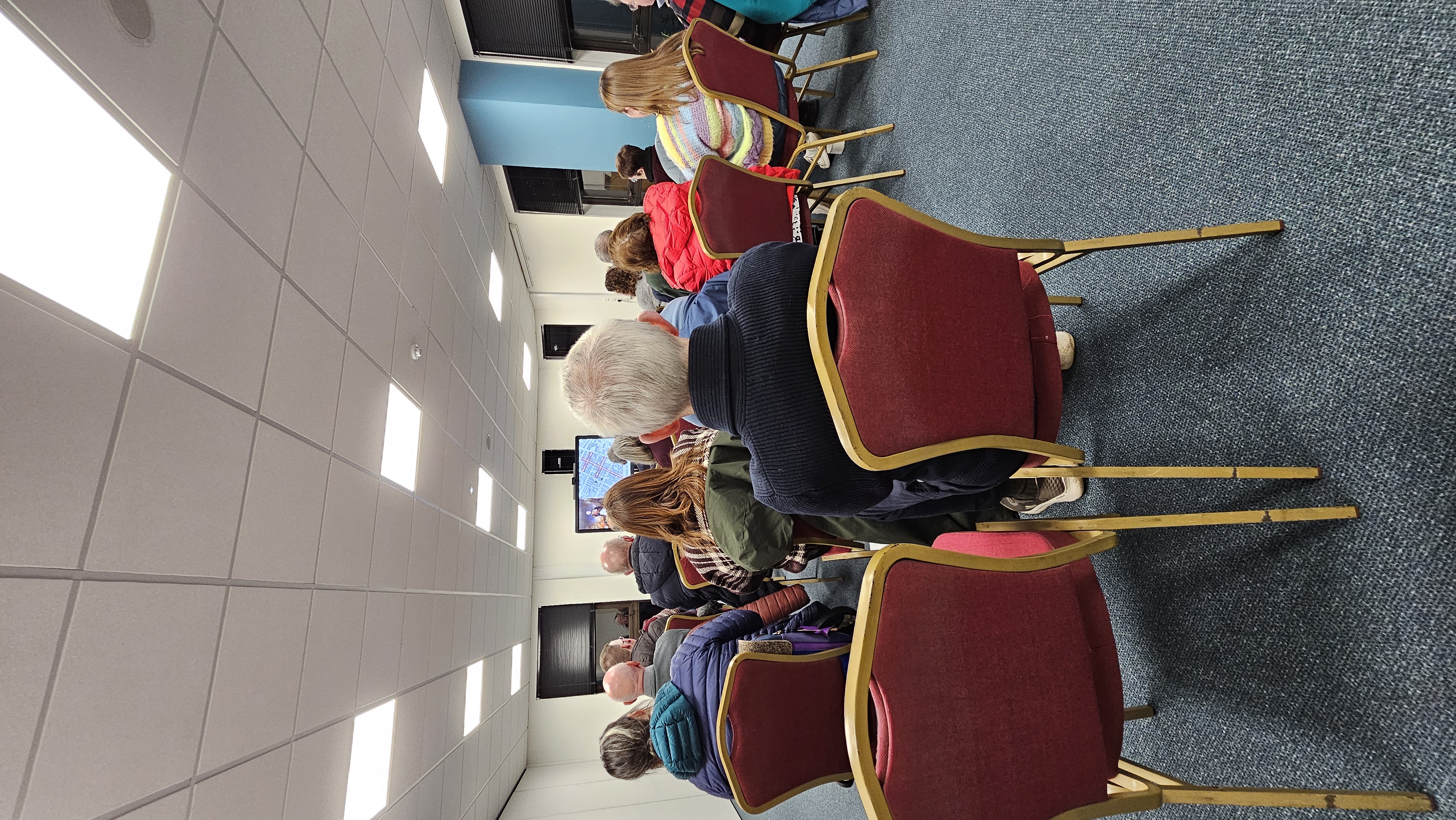
Nigel Henderson of History Hub Ulster was our guest speaker at the Annual General Meeting of BSN on 16th February 2026, which took place at Training For Women Network. He delivered a talk entitled "Belfast Street Names: Admirals, Generals and Battles". We are very grateful to Nigel for making making his notes and slides available on our website.
Photos © Heather Lindsay 2026
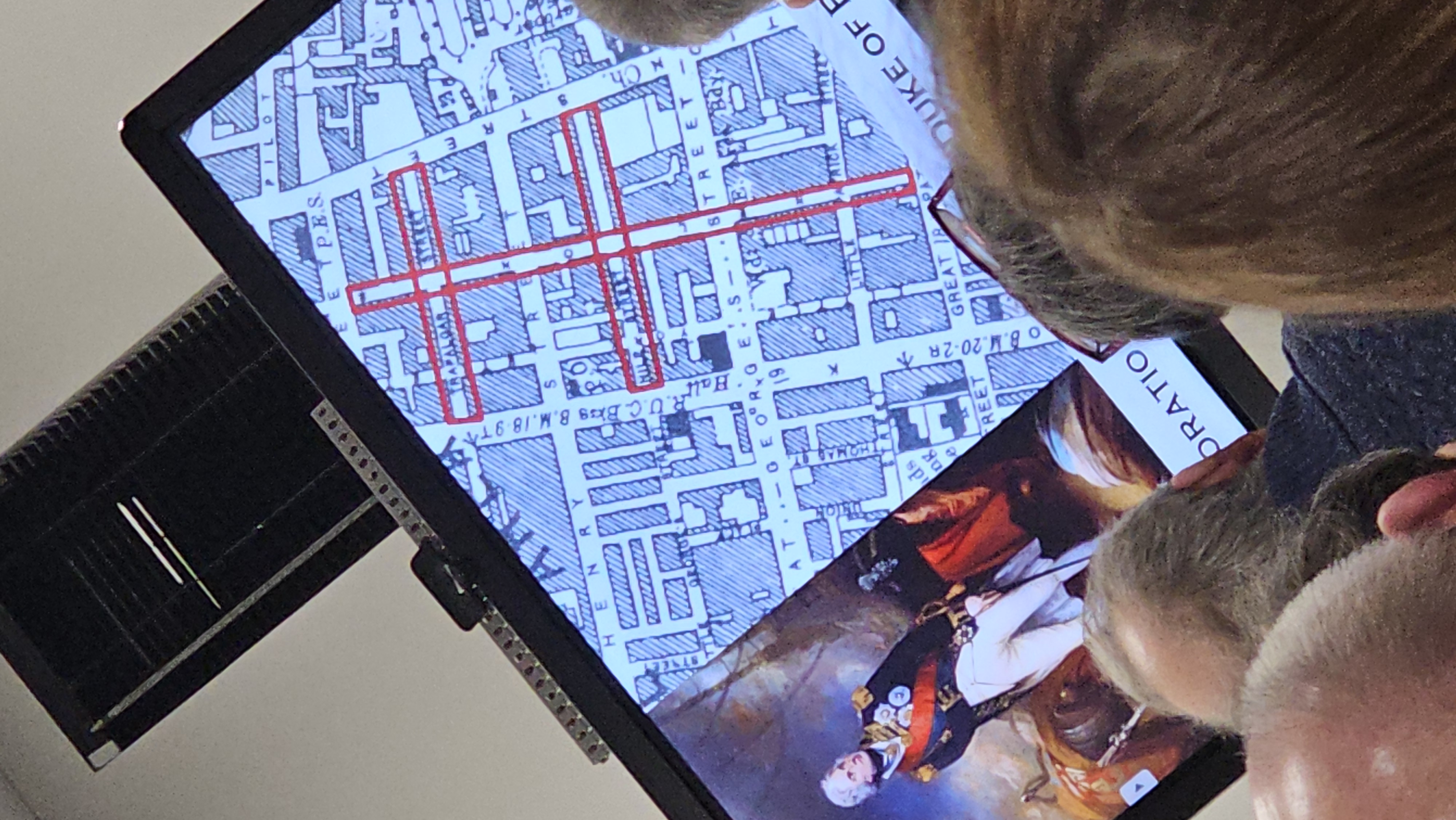
Horatio Nelson was born on 29th September 1758 in the Burnham Thorpe rectory in Norfolk to the Reverend Edmund Nelson and Catherine Suckling, being the sixth of their eleven children. He was given his first command of a ship at the age of 20 and his leadership, grasp of strategy and unconventional tactics brought about a number of decisive British naval victories during the French Revolutionary and Napoleonic Wars. He is widely regarded as one of the greatest admirals in history. His naval victories include the battles of Cape St Vincent in 1797, Copenhagen in 1801, The Nile in 1802. His most famous victory was at the Battle of Trafalgar against the Franco-Spanish fleet on 21st October 1805, during which he was fatally wounded by a French marksman. Nelson Street in Docks Ward intersects with Trafalgar Street and Nile Street.
Arthur Wellesley was born in Dublin on 1st May 1769 to Garret Wesley, 1st Earl of Mornington, and was commissioned as an ensign in the British Army in 1787. He rose to prominence as a general officer during the Peninsular War and was promoted to Field Marshal after leading British-led forces to victory against a French army at the Battle of Vitoria in 1813. Following Napoleon's first exile in 1814, he served as the British ambassador to France and was ennobled at the Duke of Wellington. During the Hundred Days campaign in 1815, Wellington commanded another British-led army which, together with a Prussian army under Field Marshal Gebhard von Blücher, defeated Napoleon at Waterloo. After retiring from military life, Wellesley turned to politics and was Prime Minister from 22nd January 1828 to 16th November 1830 and Caretaker Prime Minister from 17th November to 9th December 1834. The Duke of Wellington died on 14th September 1852, aged 83, at Walmer in Kent. Wellesley Avenue and Wellington Park between the Lisburn and Malone roads are named after him, as is Wellington Place in the city centre.
The Crimean War lasted from October 1853 to February 1856 and the protagonists were the Russian Empire against an alliance of the Ottoman Empire, the Second French Empire, the United Kingdom, and the Kingdom of Sardinia-Piedmont. There are at least seven streets in Belfast associated with the Crimean War. Most of the streets are recorded in the street directories by the 1861 edition.
Crimea Street is named after the entire war.
The Battle of Alma took place on 20th September 1854 and there is also an Alma Terrace on the Crumlin Road.
The Battle of Balaclava took place on 25th October.
The Battle of Inkerman took place on 5th November 1854. Inkerman Street is not recorded in the 1868 directory and the 1877 directory records ten small houses. The 1861 directory records an Inkerman Terrace, a set of nine properties on the Dublin Road at Ventry Lane.
The street is named after Omar Pasha, a Serbian convert to Islam, who was one of the prominent Turkish military commanders in the Crimean War. To the best of my knowledge, it is the only street in Belfast to be named after a foreign military leader.
The Siege of Sevastopol lasted from October 1854 to September 1855.
Odessa was a major port city on the Black Sea and it was bombard during a naval action in 1854. Odessa Street is not recorded in the 1877 directory but is present in the 1880 directory when there were four houses and the Clonard Mills premises of William Ross and Company.
 Horatio Herbert Kitchener was born 24th June 1850 at Gunsborough Villa near Listowel in County Kerry to Henry Horatio Kitchener, an army officer, and Frances Anne Chevallier. Both sides of his family had their roots in Suffolk, and his mother was of Huguenot descent. Kitchener was educated at Montreux and at the Royal Military Academy in Woolwich. He served with a French field ambulance unit in the Franco-Prussian War and was commissioned into the Royal Engineers on 4th January 1871. Kitchener is credited with winning the Battle of Omdurman in 1898, which secured control of the Sudan. He was ennobled as Baron Kitchener of Khartoum and served as Chief of Staff during the Second Anglo-Boer War. He then served as Commander-in-Chief of the Army in India between 1902 and 1909. At the outbreak of the Great War, Kitchener was appointed as the Secretary of State for War. On 5th June 1916, Kitchener was travelling to Russia on HMS Hampshire to attend negotiations with Tsar Nicholas II when the ship struck a German mine west of Orkney in bad weather and sank, with the loss of 737 lives. There are several streets in Belfast connected to Kitchener, including Kitchener Street, Kitchener Drive, and Soudan Street in the Village area and Khartoum Street in Ballymacarrett. As Nubia is an older name for the Sudan, it is possible that Nubia Street, which intersects with Kitchener Drive, is also connected to Horatio Herbert Kitchener.
The year 1916 links to the next military leader, Admiral John Rushworth Jellicoe. He was born on 5th December 1859 at Southampton in Hampshire to John Henry Jellicoe and Lucy Henrietta Keele. He fought in the Anglo-Egyptian War and the Boxer Rebellion and commanded the Grand Fleet at the Battle of Jutland at the end of May 1916. Jellicoe later served as First Sea Lord and as the Governor-General of New Zealand in the early 1920s. In the early 1930s, the Irish Soldiers and Sailors Land Trust built fifty semi-detached houses for veterans of the Great War on a parcel of land that had been purchased from Belfast Corporation. The houses were completed by 14th March 1935 and the new street was named Jellicoe Avenue.
Douglas Haig was born on 19th June 1861 at Charlotte Square in Edinburgh to John Richard Haig, head of the Haig & Haig whisky distillery, and Rachel Veitch. He entered the Royal Military College at Sandhurst in January 1884 and was commissioned as a Leftenant in the 7th (Queen's Own) Hussars on 7th February 1885. Haig commanded the British Expeditionary Force on the Western Front from late 1915 until the end of the war and was nicknamed "Butcher Haig" for the two million British casualties under his command. Earl Haig died on 29th January 1928. In August 1931, 72 semi-detached houses for veterans of the Great War were completed near the Cregagh Road. The streets were named Earl Haig Crescent, Earl Haig Park, and Ear Haig Gardens.
This pre-1920 map shows a part of Castlereagh Rural District that would be developed with 146 houses being built for Great War veterans and four streets named after Ulstermen who held senior positions in the British Army during the Second World War.
The Irish Soldiers and Sailors Land Trust built 146 houses on a seventeen acres parcel of land purchased from The Marquis of Downshire. The Cregagh Colony was bounded by Bell's Lane, the houses on the Cregagh Road, and open land. The streets bear the names of battles and engagements on the Western Front - Thiepval, Picardy, Bapaume, Hamel, Albert, and Somme. Bell's Lane was later extended to the Castlereagh Road and was named Montgomery Road.
 Bernard Law Montgomery was born on 17th November 1887 at Kennington in Surrey to the Reverend Henry Montgomery and Maud Farrar. The Montgomery family was part of Ulster Scots gentry and had its roots in the Innishowen Peninsula in County Donegal. Montgomery served as a junior officer with the Royal Warwickshire Regiment during the Great War and was shot through the right lung by a sniper at Méteren during the First Battle of Ypres. However, he is better known for his service in the Second World War when he commanded the Eighth Army - the Desert Rats - in North Africa, Sicily, and Italy. He was in command of all Allied ground forces from 6th June to 1st September 1944 and he commanded the 21st Army Group for the rest of the North West Europe campaign. Montgomery of Alamein died on 24th March 1976 at Isington Mill in Hampshire.
Running off Montgomery Road is Alanbrooke Road, named after Alan Francis Brooke, who was born on 23rd July 1883 at Bagnères-de-Bigorre in Hautes-Pyrénées, to a prominent Anglo-Irish family. His parents were Sir Victor Brooke of Colebrooke Park in County Fermanagh, and his mother was Alice Bellingham of Castle Bellingham in County Louth. Brooke was commissioned into the Royal Regiment of Artillery as a Second Leftenant on 24th December 1902 and served on the Western Front in the Great War. He gained a reputation as an outstanding planner of operations and in 1916, he introduced the "creeping barrage" system, which provided protection to the advancing infantry from enemy machine gun fire. In the Second World War, he distinguished himself in the handling of the British forces in the retreat to Dunkirk and played a prominent role in the decision to evacuate all British forces from France. In July 1940, Brooke was appointed as Commander-in-Chief of Home Forces, with orders to take charge of anti-invasion preparations. In December 1941, he succeeded Field Marshal Sir John Dill as Chief of the Imperial General Staff, effectively the head of the British Army. Lord Alanbrooke suffered a heart attack on 17th June 1963 and died in his bed.
Alanbrooke Road becomes Alexander Road, which was named after Field Marshal Harold Rupert Leofric George Alexander. He was born on 10th December 1891 in London to James Alexander, 4th Earl of Caledon, and Lady Elizabeth Graham-Toler. Alexander entered the Royal Military College at Sandhurst in 1910. He was commissioned as a Second Leftenant in the Irish Guards on 23rd September 1911 and served on the Western Front in the Great War, being wounded in the First Battle of Ypres and awarded the Distinguished Service Order and the Military Cross. During the Second World War, he served in Belgium and France, Burma and India, the Middle East and North Africa, Sicily and Italy. After the war he was appointed as Governor General of Canada and later as Minister of Defence between 1952 and 1954. Earl Alexander of Tunis died on 16th June 1869.
Dill Road, a short thoroughfare linking Alanbrooke Road and Alexander Road, was named after Field Marshal Sir John Dill. He was born on 25th December 1881 at Market Street in Lurgan to John Dill, a bank manager, and Jane Greer. He was educated at Methodist College and the Royal Military College at Sandhurst. Dill was commissioned as a Second Leftenant with the Leinster Regiment on 8th May 1901. During the Great War, he served as Brigade Major of the 25th Brigade. He was awarded the Distinguished Service Order and was mentioned in despatches eight times. He was also decorated by allied nations, being awarded the French Croix de Guerre and being made an Officer of the French Legion of Honour, a Commander of the Order of the Crown of Belgium, and an Officer of the Order of the Crown of Romania. From May 1940 to December 1941, he was the Chief of the Imperial General Staff and subsequently served in Washington as Chief of the British Joint Staff Mission and then as Senior British Representative on the Combined Chiefs of Staff. Field Marshal Sir John Greer Dill died in Washington on 4th November 1944 and is buried in the Arlington National Cemetery. There are only two graves in the cemetery that are marked with equestrian statues – this one for Field Marshal Dill and one for Major General Philip Kearney who was killed in the Civil War.
Slides accompanying presentation
About Nigel Henderson
Nigel Henderson is a member of History Hub Ulster. He is a History & Politics graduate of Queen’s University and his principal area of research is Belfast Presbyterians in the Great War. Click here for his full profile at History Hub Ulster.